Rever vs an Internal AI System: The Decision That Transforms Your Operations
5 minutes, 22 seconds read
Rever vs an Internal AI System:
Build vs. Buy — The Decision That Transforms Your Operations
Artificial intelligence is changing how companies build software. Today, IT departments can develop internal applications in a fraction of the time it used to take. This capability has led many manufacturing companies to consider a tempting option: building their own continuous improvement, maintenance, or quality system using AI. But is this really smarter than using a specialized platform like Rever? In this article, we analyze the pros, cons, and real costs of each approach so you can make the right decision for your operation.
The Appeal of an Internal AI System
Building internally has real advantages and it is natural that it feels attractive. A custom-built system can adapt exactly to your company’s unique processes, integrate with the legacy systems you already use, and be fully controlled by your team.
With modern AI tools, initial development is faster than ever. The idea of having a 100% proprietary solution, with no monthly subscription fees and full control over your data, is particularly appealing to senior leadership and to technology teams with available capacity.
The Hidden Costs of Building Internally
However, internal development has costs that rarely appear in the initial proposal. These are the main factors that companies systematically underestimate:
- Initial development is more complex than expected
While AI accelerates code writing, designing a robust architecture, building manufacturing-specific workflows, creating user interfaces that shop floor operators can use without technical training, and conducting thorough testing remains a months-long project requiring experienced engineers. - Ongoing and growing maintenance
Software is never finished. Bugs, security updates, changes in business processes, integrations with new equipment: all of this generates constant work for the IT team. A continuous improvement system that is not actively maintained becomes obsolete quickly and eventually the usage diminishes. - Key-person dependency
When the engineer or team that built the system changes roles or leaves the company, the knowledge about the architecture, design decisions, and integrations goes with them. This creates a critical dependency that can paralyze the system at the least opportune moment. - Adoption on the shop floor
An internal application built without a dedicated user experience (UX/UI) team makes adoption difficult. Operators need simple, intuitive interfaces. A tool that operators do not use generates no value, no matter how technically advanced it may be.
What Rever Delivers from Day 1
Rever is the result of years of iteration with hundreds of manufacturing plants across different sectors. It is not a generic application adapted for manufacturing — it is a platform built from the ground up to solve the specific challenges of the production floor.
From the very first day of implementation, Rever provides:
- Ready-to-use kaizen and continuous improvement workflows
- Daily, weekly, and monthly supervision modules for quality, safety, and maintenance
- Complete corrective action records with structured traceability for ISO, IATF, and other quality audits
- Native support for 5S and other standard manufacturing methodologies
- Performance reports that help identify cost reduction opportunities
- Mobile interface optimized for operators and supervisors on the shop floor
All of this without your IT team having to write a single line of code, and with continuous updates included in the subscription.
5 Key Differences: Rever vs Internal AI System
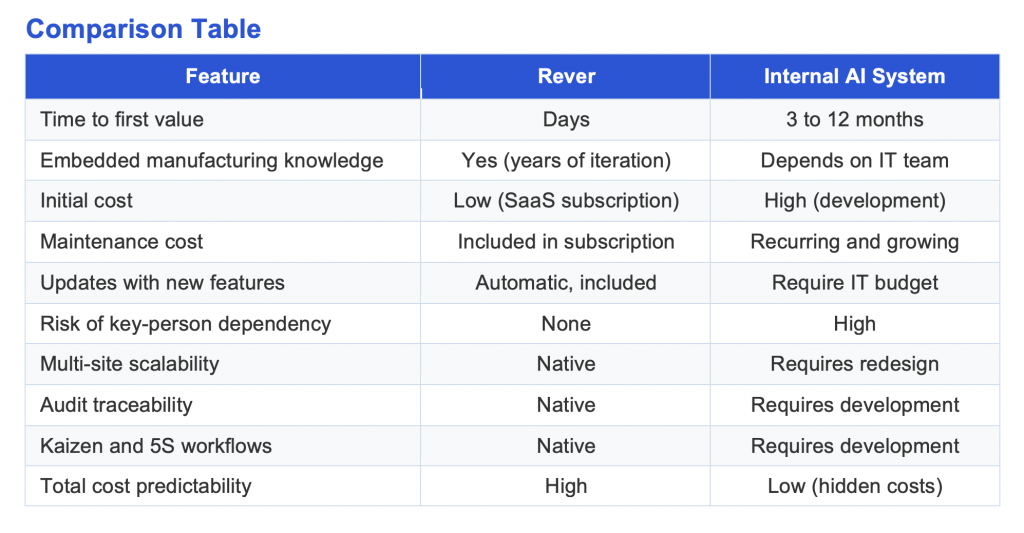
- Time to First Value
An internal system can take between 3 and 12 months to be production-ready. Rever can be implemented in days. Every week without an effective tool is a week of missed improvements, uncaptured errors, and cost reduction opportunities that slip away. - Total Cost of Ownership
Rever’s SaaS model makes cost predictable: a subscription that includes technical support, updates, and continuous improvements with no surprises. An internal system has high initial development costs plus recurring maintenance costs that inevitably grow over time and with the complexity of the operation. - Domain Knowledge
Rever was built by people who deeply understand manufacturing and continuous improvement. An internal system built by an IT team, even with AI assistance, requires that team to acquire deep knowledge of kaizen, 5S, quality audits, and plant supervision. This learning process takes time and can result in a product that misses the critical nuances of the production floor. - Scalability
If your company has multiple plants or plans to expand, Rever scales naturally. An internal system needs to be designed for scale from the beginning, or requires costly refactoring when the company grows. Experience shows that scalability is one of the most underestimated challenges in internal software projects. - Project Risk
Internal software projects have significant rates of late delivery, budget overruns, or outright failure. Rever is a battle-tested product deployed with hundreds of real customers. Adopting it is not an IT project — it is a business decision with predictable outcomes.
When Does It Make Sense to Build Internally?
Building an internal system can make sense in very specific cases: if your processes are truly unique and no solution on the market can adapt to them, if you have a very robust IT team with available bandwidth and real manufacturing expertise, or if you have extremely strict security or data sovereignty requirements that prevent using cloud software.
However, for the vast majority of manufacturing companies, building internally is more expensive, slower, and riskier than adopting a specialized platform. A manufacturing company’s competitive advantage does not come from building internal software — it comes from executing its operations better.
Conclusion
The question is not whether your IT team can build a continuous improvement system with AI. They probably can. The real question is: should your IT team dedicate months of effort to building and maintaining a manufacturing tool, when a proven platform — designed specifically for that purpose — can be running in your plant within days?
IT time and talent are scarce and valuable resources. Investing them in building tools that already exist in the market is a massive opportunity cost. Rever lets you focus that talent on the core technology challenges of your business, while your manufacturing operation benefits from a platform built and continuously evolved specifically for it.
Ready to see how much your operation can improve with Rever? Visit reverscore.com and schedule a free demo.
Like this content? Sign up for our Newsletter
[hubspot type=form portal=561211 id=fda6d445-739e-4072-8dae-68b94971a266]
THE FRONTLINE DOJO
More Articles
How to develop the next billion Knowledge Workers
3 minutes, 51 seconds read
Digital transformation in manufacturing is not what you think it is
10 minutes, 36 seconds read
The human side of change management: lessons learned from Toyota, Airbus, and Silicon Valley
1 minute, 28 seconds read
The true meaning of Genchi Genbutsu
3 minutes, 5 seconds read